OpenCHAI Architecture Flowchart
OpenCHAI is designed as a centralized cluster management and automation platform for large-scale HPC and AI environments. The architecture follows a control-plane–driven model, where all cluster components are provisioned, configured, and managed from a single OpenCHAI Manager (Head Node). This approach ensures operational consistency, scalability, and repeatability across heterogeneous infrastructure.
The architecture separates responsibilities across clearly defined node roles, enabling modular deployment, independent scaling, and high availability.
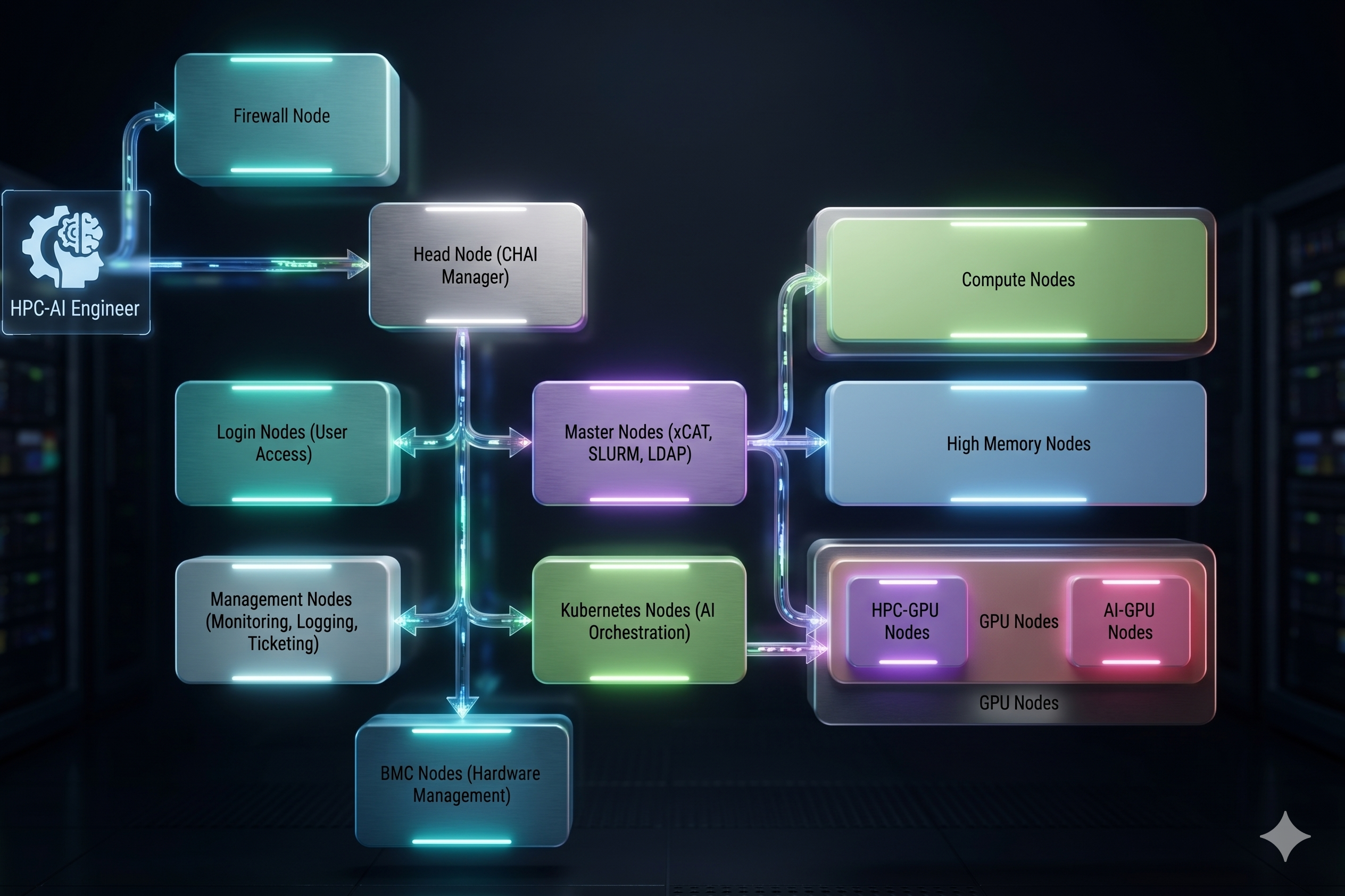
Architecture Components
This section provides a component-wise overview of the OpenCHAI cluster architecture. Each component plays a well-defined role in enabling scalable, secure, and automated HPC-AI cluster operations.
1. OpenCHAI Manager (Head Node)
The OpenCHAI Manager acts as the primary control plane for the entire cluster. It is responsible for:
End-to-end cluster provisioning and configuration
Centralized execution of automation workflows
Orchestration of service node deployments
Configuration management across all cluster roles
The manager leverages Ansible, Python, and shell-based automation to enforce infrastructure-as-code principles and maintain a consistent and reproducible cluster state.
2. Firewall Node
The firewall node provides perimeter security and network segmentation for the cluster. It controls ingress and egress traffic between external networks and internal cluster services.
Note
The firewall node operates as an external infrastructure component and is not provisioned or managed by OpenCHAI.
3. Master Nodes (xCAT, SLURM, LDAP)
Master nodes host the core control services required for orchestration, scheduling, and authentication:
xCAT for node provisioning and lifecycle management
SLURM for workload scheduling and resource allocation
LDAP for centralized authentication and authorization
These nodes form the backbone of the cluster control plane and are typically deployed in high-availability (HA) configurations.
4. Compute Nodes
Compute nodes provide the primary execution environment for HPC workloads. They are dynamically provisioned and configured by OpenCHAI based on predefined cluster profiles.
Key characteristics include:
Stateless compute execution
Centrally managed operating system images
Scheduler-controlled resource allocation
5. High-Memory Nodes
High-memory nodes are specialized compute resources designed for memory-intensive workloads such as:
Large-scale simulations
In-memory analytics
AI model training
These nodes integrate seamlessly with the same scheduling and orchestration mechanisms as standard compute nodes.
6. GPU Nodes (HPC-GPU and AI-GPU)
GPU nodes provide accelerator-based compute resources optimized for high-performance and AI workloads:
HPC-GPU Nodes for simulation and scientific computing
AI-GPU Nodes for deep learning and data-intensive workloads
OpenCHAI manages GPU node provisioning, driver configuration, and scheduler integration as part of the standard cluster lifecycle.
7. Kubernetes Nodes (AI Orchestration)
Kubernetes nodes enable container orchestration for AI and cloud-native workloads. This layer supports:
Containerized AI pipelines
Hybrid HPC-AI workloads
Integration with modern DevOps and MLOps workflows
Kubernetes is deployed and managed as a first-class component within the OpenCHAI ecosystem.
8. Login Nodes (User Access)
Login nodes provide controlled user access to the cluster environment. They act as secure entry points for users to:
Submit jobs
Manage workflows
Access shared resources
These nodes are isolated from compute execution to enhance system security and operational stability.
9. Management Nodes (Monitoring, Ticketing)
Management nodes host operational and observability services, including:
Cluster monitoring and health checks
Alerting and event tracking
Operational support and ticketing integrations
This separation ensures that management workloads do not interfere with compute or scheduling operations.
10. BMC Nodes (Hardware Management)
BMC (Baseboard Management Controller) nodes enable out-of-band hardware management, including:
Power control
Hardware health monitoring
Remote troubleshooting
OpenCHAI integrates with BMC interfaces to support automated provisioning, recovery, and lifecycle management workflows.
Architectural Benefits
The OpenCHAI architecture delivers the following enterprise-grade benefits:
Centralized control with distributed execution
Modular, role-based cluster design
Scalability across HPC and AI workloads
Production-ready enterprise architecture
Reduced operational overhead and deployment complexity